



Function
Boston Soft Footbed em couro oleado: Adaptação da primeira semana, ajuste da tira e caminhada em piso duro | BIRKENSTOCK Oficial
Why the First Week Matters More Than Any Other
The Boston Soft Footbed in oiled leather is not a shoe you judge in the first hour. The cork-latex footbed underneath your arch is still learning your foot, and your foot is still learning the footbed. This is normal. It is also the part most people rush. The first week is when the cork compound begins to compress at the heel and the metatarsal, when the oiled leather upper starts to crease where your foot flexes, and when the strap either becomes a partner or a problem. Get these days right and the Boston becomes a daily habit. Get them wrong and you blame the shoe for something that was simply a matter of pacing.
The Cork-Latex Footbed: What Is Actually Happening Underfoot
BIRKENSTOCK builds the footbed from cork and natural latex, a combination that is firm at first and then yields to heat and pressure. In the Boston Soft Footbed, an extra layer of foam sits between the cork and the suede lining, which softens the initial contact without changing the shape of the arch or the deep heel cup. That means you still get the same support that made the original footbed famous, but the first few days feel less like standing on a wooden plank. The cork is not broken in by walking a mile. It is broken in by walking short distances, then letting the footbed rest. The latex needs time to rebound, and the cork needs time to hold the new shape. This is the opposite of a foam midsole, which compresses permanently and never recovers. Cork-latex adapts and then stays adapted.
Strap Fit: Loose Is Not the Goal, Tight Is Not the Answer
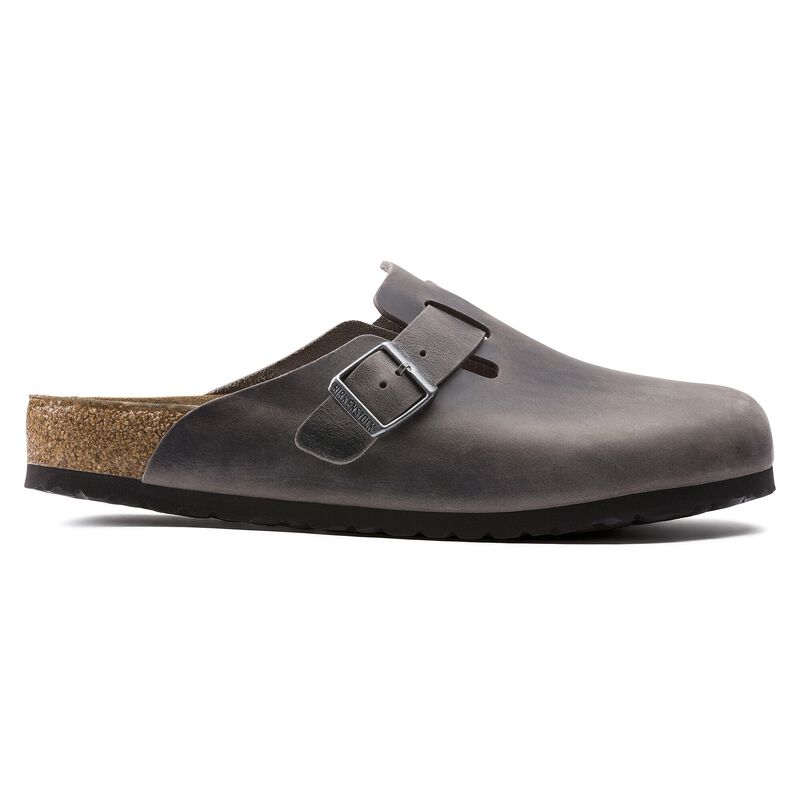
The Boston is a clog, so the strap across the instep is your only adjustment. A common mistake in the first week is cinching it down to feel secure. That flattens the footbed's arch and pushes your heel forward into the toe box. Instead, fasten the strap so you can slide one finger between it and the top of your foot. The oiled leather will soften and stretch slightly with wear, so a fit that feels almost too relaxed on day one is usually correct by day seven. If you have a high instep, start on the looser hole. If you have a narrow foot, the strap will do more work, but still avoid overtightening. The goal is to keep the foot from sliding forward without clamping down on the instep. Habana and Iron oiled leather both break in the same way, though Habana shows scuffs more readily and Iron hides them until the light hits. Neither needs a conditioner in the first week. Let the leather do its own work.
Walking on Hard Floors: The Real Test
Tile, concrete, hardwood, and stone are unforgiving surfaces. They expose every flaw in a footbed that has not yet molded to your foot. For the first three days, wear the Boston Soft Footbed indoors on hard floors for twenty to thirty minutes at a time. You will feel the cork pressing back against your arch. That is the footbed taking an impression. If you stand for long periods on hard floors, shift your weight from heel to toe slowly, and avoid rocking side to side. The deep heel cup is designed to keep your heel centered, but it only works if your foot lands naturally. On day four, try a short outdoor walk on pavement. By day seven, the cork should feel less like a foreign object and more like a floor you happen to be wearing. The soft footbed shortens this timeline, but it does not eliminate it. If you wear the Boston on hard floors for eight hours straight on day one, you will feel it in your knees and lower back. That is not the shoe failing. That is the shoe asking for patience.
The Soft Footbed Difference in the First Week
The original BIRKENSTOCK footbed is firm. Some people love that from the first step. The Soft Footbed adds a layer of foam that compresses immediately, giving you a gentle landing while the cork underneath begins its slower work. In the first week, this means less shock on hard floors and less initial pressure at the heel. It does not mean the footbed is soft like a sneaker. It is still a cork footbed. The foam is a bridge, not a replacement. By the end of the first week, the foam has taken a set and the cork has started to follow your arch. You should notice that the Boston feels different on day seven than it did on day one, even if you cannot point to exactly what changed. That is the sign that the break-in is working.
Oiled Leather: Habana and Iron
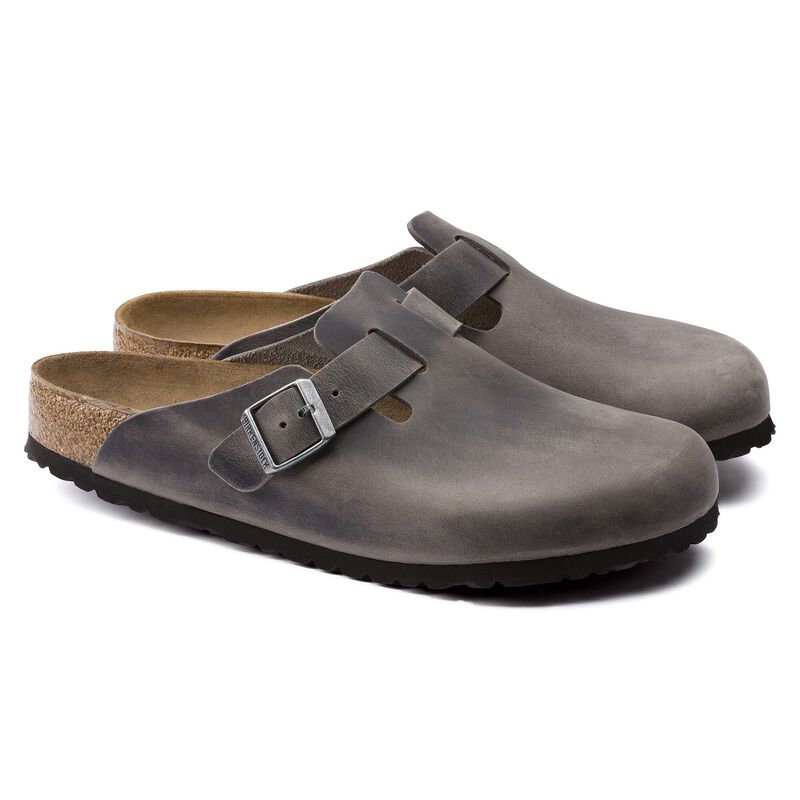
Oiled leather is treated with natural oils and waxes, which makes it supple and resistant to light moisture. Habana is a deep, warm brown that develops a patina quickly, especially at the flex point across the toes. Iron is a dark, cool grey-brown that reads almost black in low light but shows its true color in daylight. Both colors will crease. That is not a defect. It is the leather responding to your foot. In the first week, you may notice the strap leaving a faint line on the top of your foot. That line will fade as the leather softens. Do not treat the leather with heavy conditioners during the break-in period. If the surface feels dry after a week, a thin coat of neutral leather cream is enough. Otherwise, leave it alone.
Width, Sizing, and the Break-In Timeline
BIRKENSTOCK offers the Boston in narrow and regular widths. The footbed itself is the same shape, but the upper and the strap are cut differently. If you are between sizes, choose the smaller size for the Boston, because the clog shape allows your heel to sit slightly forward without hitting the back edge. During the first week, your foot may slide forward if the strap is too loose. That is a sign to adjust the strap, not to size down. The break-in timeline varies: most people feel a noticeable change by day four and a full adaptation by day fourteen. Hard floors slow it down because they demand more from the cork. Soft carpets speed it up because they let the footbed rest. Neither is better. The footbed adapts to whatever surface you walk on most.
Common First-Week Mistakes

Wearing the Boston for a full day immediately. Wearing them with thick socks if you normally wear thin ones. Overtightening the strap to stop your heel from lifting. Walking long distances on concrete before the cork has taken an impression. Ignoring the arch because it feels strange. All of these are understandable, and all of them extend the break-in. The better approach is short sessions, hard floors included, with the strap snug but not tight. If your arch aches after twenty minutes, take the shoe off and let the footbed cool. The cork will hold the shape it was in when it cooled. That is why rest matters as much as wear.
After the First Week: What to Expect
By day seven, the Boston Soft Footbed should feel less like a new shoe and more like a shoe you have owned for a month. The cork will have a visible impression of your heel and forefoot. The oiled leather will have softened at the strap and across the toes. You will be able to walk on hard floors for longer periods without thinking about your feet. At that point, the break-in is not finished, but the hardest part is over. The footbed will continue to adapt for another week or two, and then it will stabilize. From then on, the Boston is a walking shoe in the original sense: a shoe that lets your foot do what it was designed to do, on whatever surface you happen to be standing.
Walking as Nature Intended, One Week at a Time
BIRKENSTOCK has been making cork-latex footbeds in Germany for generations, and the Boston Soft Footbed is a direct continuation of that work. The first week is not a hurdle. It is the process. The strap fit, the hard floors, the slow molding of cork to foot—these are not inconveniences. They are the reason the shoe lasts. Give the Boston a week of mindful wear, and it will give you a footbed that fits no one else. That is the deal. Habana or Iron, narrow or regular, the cork does the rest.
View this BIRKENSTOCK style in the shop
People also search
is BIRKENSTOCK Boston Soft Footbed Natural Leather Oiled Iron Walk Edit true to size
best BIRKENSTOCK for backyard home and errands
BIRKENSTOCK Arizona for wide feet reddit fit
best BIRKENSTOCK for city walking tour
BIRKENSTOCK Arizona white vs black everyday wear
BIRKENSTOCK Gizeh regular vs platform
BIRKENSTOCK Madrid big buckle trend 2026
BIRKENSTOCK Boston Soft Footbed Natural Leather Oiled Iron Walk Edit sizing and width fit
BIRKENSTOCK Arizona taupe vs stone vs black which to buy
BIRKENSTOCK cork latex footbed how long it lasts
BIRKENSTOCK Arizona for men first pair guide
best BIRKENSTOCK for airport travel and long flights
best color for BIRKENSTOCK Boston Soft Footbed Natural Leather Oiled Iron Walk Edit everyday wear
BIRKENSTOCK sandals for sightseeing Europe cobblestones
BIRKENSTOCK Boston shearling vs regular Boston
are BIRKENSTOCK cork footbed sandals good for all-day walking
best BIRKENSTOCK sandals for standing all day at work
BIRKENSTOCK Birko-Flor vs leather which lasts longer
BIRKENSTOCK wide width sandals for high volume feet
BIRKENSTOCK sandals lightweight hiking light trails
BIRKENSTOCK sizing guide regular vs wide width
BIRKENSTOCK Boston taupe suede outfit ideas
BIRKENSTOCK Boston suede water stains how to clean
BIRKENSTOCK Boston vs Milano which for commute
how to stretch tight BIRKENSTOCK sandals at home
BIRKENSTOCK soft footbed vs original footbed difference
how long to break in BIRKENSTOCK cork footbed
BIRKENSTOCK arch support sandals for sightseeing
BIRKENSTOCK oiled leather clog care rain and commute
how to choose BIRKENSTOCK width letter R or N
Trending BIRKENSTOCK searches
BIRKENSTOCK travel sandals
BIRKENSTOCK sizing
BIRKENSTOCK Boston clog
BIRKENSTOCK EVA sandals
BIRKENSTOCK stone Arizona
BIRKENSTOCK new colors
break-in cork footbed
regular vs wide BIRKENSTOCK
Arizona vs Boston
BIRKENSTOCK Gizeh
Birkenstock clog socks
oiled leather clog care
BIRKENSTOCK last chance
BIRKENSTOCK 2026 trends
BIRKENSTOCK city walking
BIRKENSTOCK Boston Soft Footbed Natural Leather Oiled Iron Walk Edit
BIRKENSTOCK Arizona
BIRKENSTOCK Mayari
BIRKENSTOCK soft footbed
BIRKENSTOCK wide width
