



Function
BIRKENSTOCK London fivela de arame couro natural Vintage Wood Black sola macia: primeira semana de adaptação, ajuste das tiras e caminhada em piso duro · BIRKENSTOCK Oficial
Why the London Deserves a Slow First Week
The BIRKENSTOCK London is a closed-back, low-cut shoe that carries the same orthopedic architecture as the brand's open-back classics. This version uses natural leather in Vintage Wood Black or Vintage Wood Roast, a wire buckle closure, and a soft sole. The silhouette is restrained, but the footbed inside is the uncompromising cork-latex unit that has defined BIRKENSTOCK since the beginning. If you are coming from a sneaker or a dress shoe with a foam insole, the first week will feel different. That is not a defect. It is the footbed asking your foot to participate.
Walking as nature intended means letting the foot move over a surface that yields just enough, then holds its shape. Cork does exactly that. It is harvested from the cork oak, ground, and mixed with latex. The result is a footbed that starts firm and becomes a record of your gait. The London's soft sole adds a layer of flexibility under the cork, which changes the break-in conversation slightly. You still get the same contouring, but the shoe bends more readily from day one. That makes the first week less about fighting stiffness and more about learning where the shoe wants your weight to land.
Day 1 to Day 3: What the Cork-Latex Footbed Actually Does
On the first day, put the London on indoors. Stand still for a minute. You should feel the raised arch, the deep heel cup, and the slight ridge under the toes. These are not decorative. The arch support encourages the midfoot to stay active. The heel cup centers the heel bone and cushions the fat pad. The toe ridge gives the toes something to grip, which is how a foot stabilizes itself when it is not being held by a stiff shank.
In the first three days, wear the London for short periods. Twenty minutes around the house, then forty. The cork-latex begins to warm and soften at the pressure points. You may notice a slight imprint forming under the ball of the foot and along the outer edge of the heel. That is normal. The footbed is not collapsing; it is adapting. Natural leather uppers also begin to relax across the instep. The Vintage Wood Black and Vintage Wood Roast finishes are dyed through, so the leather will crease rather than crack as it flexes.
Do not wear the London for a full workday on day one. The footbed needs time to respond, and your foot needs time to adjust to a different distribution of pressure. If you feel heat or rubbing at the heel, check the strap fit before blaming the shoe.
Strap Fit: The Wire Buckle and the Instep
The London uses a wire buckle across the instep. This is not a decorative buckle. It is the primary adjustment for volume. The strap should hold the midfoot without pinching. A common mistake is to tighten the buckle until the leather presses hard against the top of the foot. That restricts circulation and forces the toes to curl. Instead, fasten the buckle so you can slide one finger under the strap with mild resistance. The leather will stretch slightly as it breaks in, so a snug-but-not-tight fit on day one becomes a secure fit by day seven.
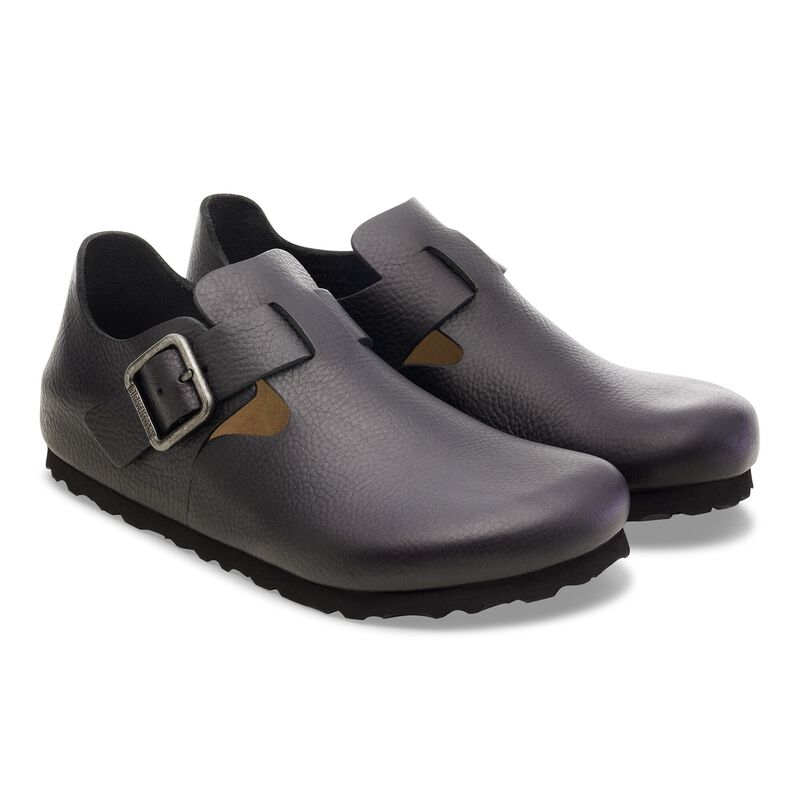
If you have a high instep, start on the looser hole. If you have a low instep, start on the tighter hole. The wire buckle is thin, so it does not create a bulky pressure point. It also allows micro-adjustments that a standard pin buckle cannot. For the Vintage Wood Roast, the leather is slightly more supple out of the box, so you may need to tighten the buckle one notch sooner than with the Vintage Wood Black.
Width matters here. The London is available in narrow and regular fits. A narrow foot in a regular width will slide forward and jam the toes. A wide foot in a narrow width will bulge over the footbed edge. If you are between sizes, size down for the narrow fit and stay true for the regular. The strap can only compensate so much. The cork-latex footbed is the real foundation.
Day 4 to Day 7: Walking on Hard Floors
Hard floors are the true test of any footbed. Concrete, tile, and hardwood do not absorb impact. They send it back up through the shoe. This is where the cork-latex footbed earns its reputation. Unlike foam, cork does not pack out into a flat pancake. It compresses at the high points and remains resilient elsewhere. By day four, you should feel the arch support meeting your foot rather than pressing into it. By day seven, the heel cup should feel like it was made for you.
The soft sole on this London adds a thin layer of cushioning under the cork. On hard floors, that translates to a slightly quieter step and a bit more give at the forefoot. It does not turn the London into a running shoe. It simply takes the edge off the first impacts while the cork continues to mold. If you walk on hard floors all day, alternate the London with another pair during the first week. The footbed needs rest to recover its shape, just as your foot does.
Pay attention to your heel strike. The deep heel cup encourages a more centered landing. If you usually walk with a heavy outer-heel strike, the London will feel strange at first. That is the footbed asking you to land more evenly. Give it the week. Most people find that the cork-latex footbed reduces the sharpness of hard-floor walking without making the foot lazy.
Natural Leather, Soft Sole, and the Long View
Natural leather is not a synthetic upper. It breathes, it creases, and it takes on the shape of the foot over time. The Vintage Wood Black is a deep, near-black finish with subtle brown undertones. The Vintage Wood Roast is warmer, with a reddish-brown cast. Both are designed to age rather than stay pristine. A scuff on natural leather can often be buffed back with a horsehair brush and a little leather conditioner. Do not soak the leather. Do not machine wash the London. Wipe it with a damp cloth and let it dry away from direct heat.
The soft sole is a specific construction. It is more flexible than the standard sole, which suits the London's closed-back design. It also means the shoe can twist slightly with the foot. That flexibility is helpful during break-in because it reduces the leverage that a stiff sole puts on the upper. But it also means the cork-latex footbed is doing more of the structural work. Keep the footbed dry. If it gets wet, let it air dry naturally. Heat will make the cork brittle.
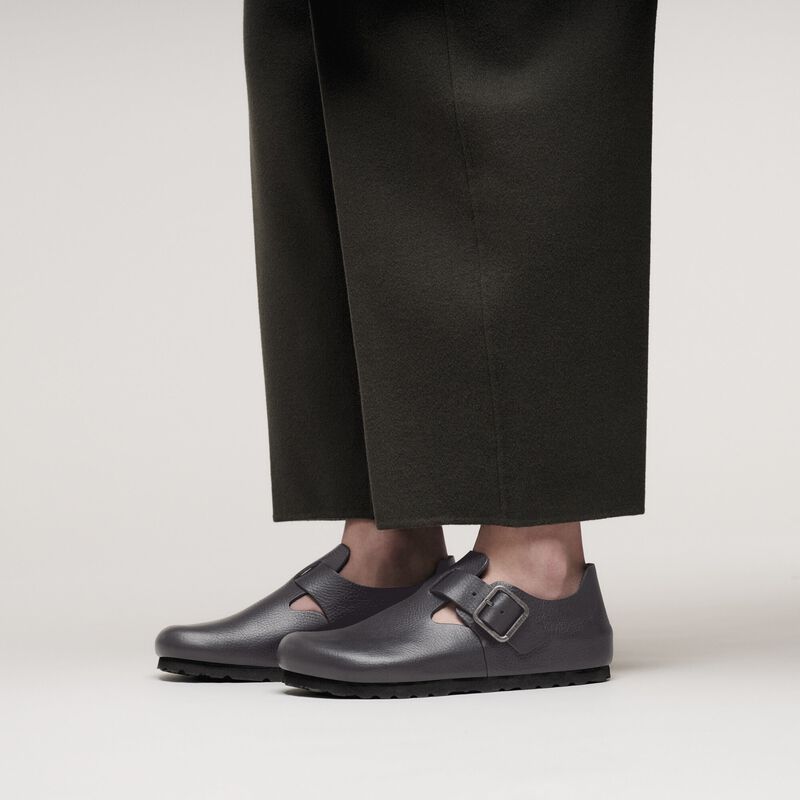
After the first week, the London should feel less like a new shoe and more like a tool. The cork-latex footbed will have a visible imprint of your heel and forefoot. The leather will have creases across the instep. The wire buckle will sit in a familiar notch. That is the point. BIRKENSTOCK does not build shoes to feel broken-in on day one. It builds them to feel correct on day thirty and day three hundred.
Hard-Floor Walking: Practical Notes
If your day is mostly standing on concrete, the London's cork-latex footbed will help, but it is not a magic carpet. Use the first week to build tolerance. Stand for ten minutes, then sit. Walk for twenty, then rest. The footbed adapts faster when it is not overheated by constant pressure. On tile, the soft sole gives slightly more grip than a hard sole, but this is still a leather-soled shoe. Avoid wet, oily, or highly polished surfaces until the sole has scuffed slightly.
On hardwood, the London is quiet and stable. The heel cup keeps the foot from sliding, and the arch support reduces the tendency to pronate. If you feel the arch pressing too hard, loosen the wire buckle one notch. If you feel the heel slipping, tighten it. The strap and the footbed work together. A loose strap on a hard floor makes the foot work harder. A tight strap makes the foot numb. Find the middle.
By the end of the first week, you should be able to wear the London for a normal day on hard floors without thinking about your feet. That is the goal. Not softness. Not instant comfort. A quiet, supportive platform that lets your foot do what it evolved to do.
Colors, Care, and the BIRKENSTOCK Standard
The London Wire Buckle Natural Leather Vintage Wood Black Soft Sole is the darker option. It pairs with dark denim, wool trousers, and most workwear. The Vintage Wood Roast is the warmer option, with a brown-red tone that shows more variation as the leather ages. Both use the same cork-latex footbed, the same wire buckle, and the same soft sole. The choice is visual, not structural.
Clean the leather with a soft brush. Condition it sparingly. If the cork footbed develops an odor, air it out and use a mild footbed freshener. Do not submerge the shoe. Do not put it in a washing machine. Do not leave it in a hot car. Cork and leather are natural materials. They respond to care the way a wooden floor responds to polish. A little attention goes a long way.
The London is not a fashion sneaker. It is a BIRKENSTOCK. That means the footbed is the point. The natural leather, the wire buckle, and the soft sole are there to support the footbed, not replace it. Give the first week the time it asks for. Fasten the strap correctly. Walk on hard floors with attention. The cork will do the rest.
View this BIRKENSTOCK style in the shop
People also search
BIRKENSTOCK EVA sandals for beach and pool
BIRKENSTOCK Arizona vegan Birko-Flor vs leather
how long to break in BIRKENSTOCK cork footbed
BIRKENSTOCK Boston fit compared to Arizona
BIRKENSTOCK footbed sandals break-in no blisters
are BIRKENSTOCK sandals good for cobblestone city streets
BIRKENSTOCK London Wire Buckle Natural Leather Vintage Wood Black Soft Sole sizing and width fit
BIRKENSTOCK footbed packed out when to replace
how often to replace BIRKENSTOCK cork footbed
BIRKENSTOCK Boston suede water stains how to clean
BIRKENSTOCK sizing guide regular vs wide width
is BIRKENSTOCK London Wire Buckle Natural Leather Vintage Wood Black Soft Sole true to size
how to stretch tight BIRKENSTOCK sandals at home
BIRKENSTOCK sandals lightweight hiking light trails
BIRKENSTOCK footbed sandals for standing on hard floors
BIRKENSTOCK Gizeh regular vs platform
BIRKENSTOCK Arizona last chance colors worth buying
BIRKENSTOCK oiled leather clog care rain and commute
BIRKENSTOCK sandals for plantar comfort walking
BIRKENSTOCK Arizona taupe vs stone vs black which to buy
how to stop heel slipping in BIRKENSTOCK Arizona
BIRKENSTOCK kids vs adult sizing for small feet
best color for BIRKENSTOCK London Wire Buckle Natural Leather Vintage Wood Black Soft Sole everyday wear
BIRKENSTOCK Arizona for wide feet reddit fit
best BIRKENSTOCK sandals for standing all day at work
BIRKENSTOCK Arizona white vs black everyday wear
BIRKENSTOCK cork latex footbed how long it lasts
BIRKENSTOCK Arizona for summer walking all day
are BIRKENSTOCK cork footbed sandals good for all-day walking
BIRKENSTOCK Arizona oiled leather darkens over time
Trending BIRKENSTOCK searches
BIRKENSTOCK soft footbed
BIRKENSTOCK oiled leather
BIRKENSTOCK taupe suede
BIRKENSTOCK new colors
BIRKENSTOCK city walking
BIRKENSTOCK London Wire Buckle Natural Leather Vintage Wood Black Soft Sole
BIRKENSTOCK Arizona
BIRKENSTOCK white Arizona
BIRKENSTOCK Gizeh
oiled leather clog care
London Wire Buckle Natural Leather Vintage Wood Black Soft Sole Birko-Flor
BIRKENSTOCK shearling Boston
BIRKENSTOCK Kyoto clog
BIRKENSTOCK Birko-Flor
regular vs wide BIRKENSTOCK
BIRKENSTOCK for work standing
BIRKENSTOCK Big Buckle
BIRKENSTOCK 2026 trends
ankle strap Milano
thong sandal Gizeh
