



Function
Mayari Nubuck Leather Pure Sage City Comfort: First-Week Break-In and Strap Fit Guide | BIRKENSTOCK Official
The Mayari in Pure Sage: A Nubuck Leather Sandal Built on Cork
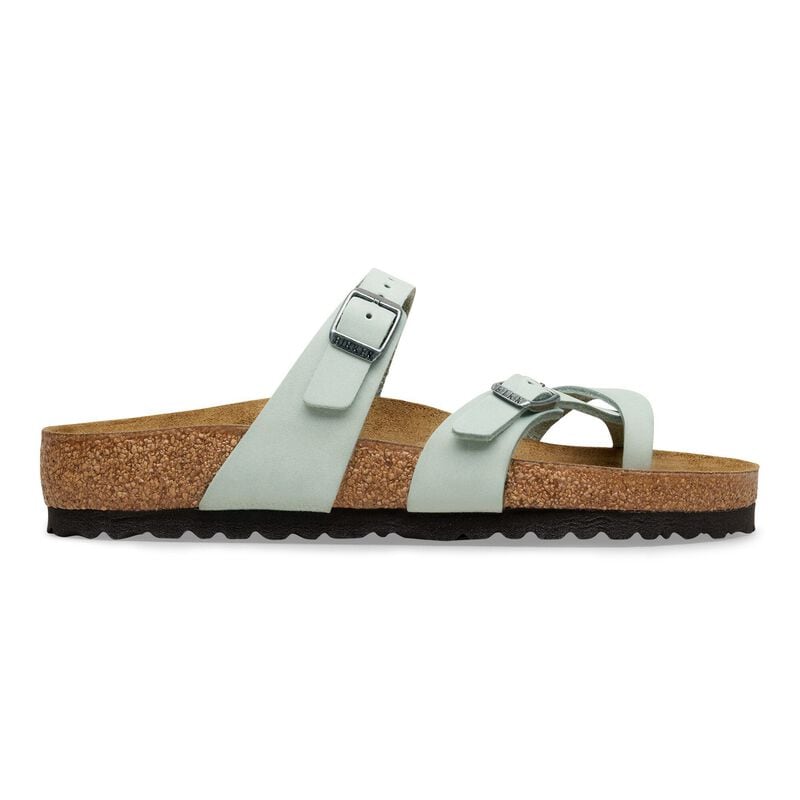
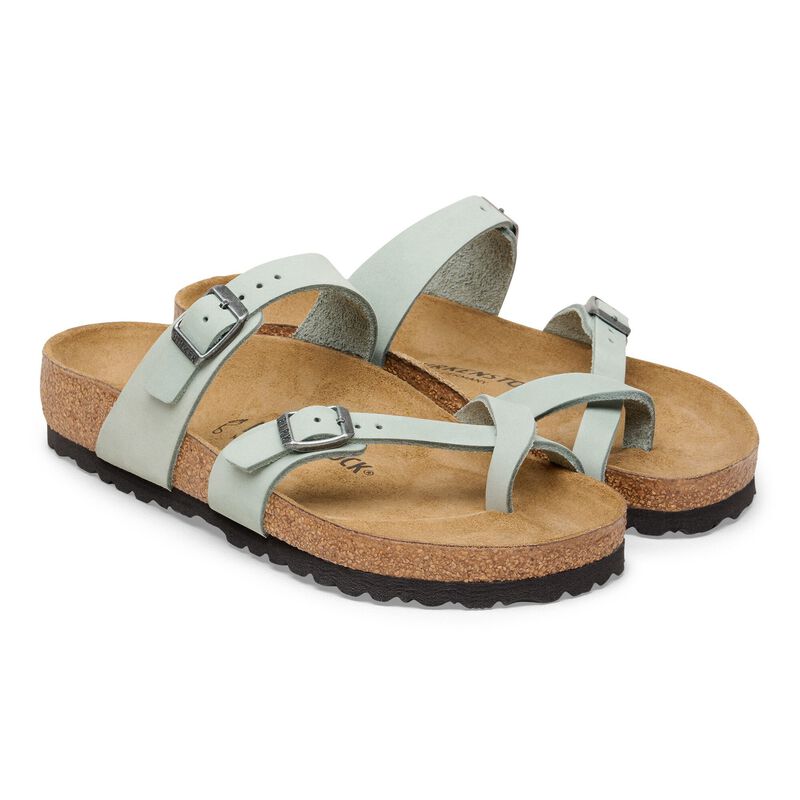
The Mayari is a two-strap sandal with a difference: the straps cross the foot in a way that holds the instep and the toe together, and the upper is nubuck leather. Nubuck is leather that has been buffed on the grain side, so it has a soft, velvety surface that takes color deeply. In Pure Sage, that surface reads as a muted, herbal green that sits well with linen, denim, and worn canvas. The same model is also made in Ecru, Faded Lime, and Stone Blue, but the Pure Sage City Comfort version is the one we are walking through here. Underneath the leather is the part that matters most for your feet: the cork-latex footbed. This is not a foam insole. It is a mixture of cork granules and natural latex, pressed into a mold that follows the contours of a healthy foot. The footbed is the foundation of every BIRKENSTOCK sandal, and it is why the first week feels different from any other shoe you own.
What Happens to the Cork Footbed in the First Week
A new cork-latex footbed is firm. It has a slight sheen on the surface, and the edges of the heel cup and toe bar are clearly defined. When you first put on the Mayari, you will feel those contours pressing up against your arch and the ball of your foot. That is not a defect; it is the footbed doing its job. Cork is a natural material that responds to heat and pressure. After a few hours of walking, your body heat softens the cork-latex just enough for it to begin to yield. By the end of the first day, you may notice a faint impression of your heel and toes in the footbed. By the end of the first week, that impression becomes a personal mold. The arch support will feel less like a bump and more like a shelf that your foot rests on. The toe bar, which sits just behind the ball of the foot, will stop feeling like a ridge and start feeling like a guide that keeps your foot from sliding forward. This is the break-in. It is not a matter of stretching the leather or forcing the sandal to bend; it is a matter of the cork-latex adapting to you. The process is slower in cold weather and faster in warm weather. If you wear the Mayari for an hour or two a day for the first week, the footbed will begin to take your shape without ever feeling painful. If you wear them for eight hours straight on day one, you may feel tenderness in the arch, but that is simply the footbed asking for a little more time. There is no need to wet the footbed or put them in the oven. Just walk.
Strap Fit: How to Dial In the Mayari's Crisscross Upper
The Mayari has two straps that cross over the foot. One strap runs from the inner arch across the top of the foot to the outer side, and the other runs from the outer side across the toes to the inner side. They meet in the middle and are held by a single buckle on the outer side. This design gives you two points of adjustment: the buckle itself, and the loop that the strap passes through. When you first try on the Mayari, undo the buckle and loosen the strap so that you can slide your foot in without forcing it. Your heel should sit squarely in the heel cup, with about a finger's width of space behind it. The toe bar should sit just behind the ball of your foot, not under your toes. Once your foot is in place, pull the strap until it is snug but not tight. You should be able to slide one finger under the strap at the highest point of your instep. If the strap leaves a red mark after a few minutes, it is too tight. If your foot slides forward when you walk, it is too loose. The nubuck leather will soften and stretch slightly with wear, so it is better to start with the strap a little looser than you think you need. After a few days, you can tighten it by one hole. The crisscross design also means that the straps will gradually take on the shape of your foot. The leather will crease where your foot flexes, and those creases will make the sandal feel more like a second skin. Do not try to force the leather to stretch by pulling on the straps; let your walking do the work. If you have a high instep, you may need to use the last hole on the strap. If you have a low instep, you may need to punch an extra hole, but that is rarely necessary because the nubuck leather has enough give. The goal is a fit that holds your foot without gripping it, so that the footbed can do its job.
Walking on Hard Floors: Why the Cork Footbed Matters
Most shoes sold today have a foam midsole. Foam is soft at first, but it compresses and loses its shape within a few months. Cork-latex is different. It is firm, but it is also elastic. When you walk on a hard floor—concrete, tile, hardwood—the footbed absorbs the impact and returns a small amount of energy to your step. This is not cushioning in the conventional sense; it is support. The arch of the footbed keeps your foot from collapsing inward, and the heel cup keeps your heel from rolling outward. The result is a gait that feels more deliberate. You will notice that you walk with your feet slightly more parallel, and that your toes have room to spread. On a hard floor, a foam shoe feels like walking on a marshmallow that slowly goes flat. The Mayari feels like walking on a firm, responsive surface that encourages you to use your own muscles. That is the heritage orthopedic approach: the shoe does not do the work for you; it gives your foot a stable platform so that your foot can do the work. In the first week, you may feel your calves and the arches of your feet working a little harder than usual. That is normal. Your feet are waking up. If you are used to heavily cushioned shoes, the transition can take a few days. Start by wearing the Mayari around the house or for short errands. After a week, you will likely find that hard floors feel less jarring, not because the shoe is soft, but because your feet are stronger and your gait is more efficient. The cork-latex footbed is the reason. It is a material that has been used in German orthopedic footwear for generations, and it is still made in Germany for BIRKENSTOCK. The Mayari in Pure Sage, Ecru, Faded Lime, and Stone Blue all share the same footbed. The difference is only in the upper.
Nubuck Leather: Care in the First Week and Beyond
Nubuck leather is more vulnerable to water and oil than smooth leather. In the first week, avoid wearing your Mayari in the rain. If they get wet, blot them with a dry cloth and let them air dry away from direct heat. Do not use a hair dryer or put them on a radiator; that will crack the leather and shrink the cork. If you want to protect the nubuck, use a nubuck spray before the first wear. That will help keep the Pure Sage color from picking up dirt. A soft brush can be used to lift the nap if it becomes flattened. The cork-latex footbed itself needs no care beyond keeping it dry. If it becomes dirty, wipe it with a damp cloth and let it dry. Do not soak it. Over time, the footbed will darken slightly from your feet, which is normal and a sign that it is molding to you.
Width and Fit: What to Know Before You Buy
The Mayari is available in two widths: narrow and regular. The width refers to the footbed, not the straps. If you have a wide foot, choose the regular width. If you have a narrow foot, choose the narrow width. If you are between sizes, go with the larger size, because the footbed should not be too short; your toes should not touch the front edge. A proper fit has about a quarter-inch of space in front of your longest toe. The straps can be adjusted, but the footbed cannot. So get the length and width right first. The Mayari in Pure Sage is a unisex sandal, but the sizing is in European sizes. If you normally wear a US size, check the BIRKENSTOCK size chart to convert. The footbed is designed to be worn with bare feet. If you wear socks, the fit will be different, and the break-in will take longer because the sock adds a layer between your foot and the cork. For the first week, bare feet are best.
The First Week, Day by Day
Day one: wear the Mayari for one to two hours. Walk around your home. Notice where the footbed touches your arch and heel. Day two: wear them for three to four hours. If you can, walk outside on a hard surface. Pay attention to how your heel lands. Day three: wear them for a half day. You may notice that the footbed feels slightly softer. Day four: wear them for a full day if you are comfortable. The nubuck will begin to crease over your instep. Day five: the footbed should feel noticeably more accommodating. The arch support may feel like it has always been there. Day six: try a longer walk. The sandal should feel stable, not wobbly. Day seven: by now, the cork-latex has started to take your shape. The straps should be adjusted to your final fit. You are through the break-in. From here, the Mayari will continue to mold to your foot for months, but the major changes happen in the first week. After that, it is maintenance: keep them dry, brush the nubuck occasionally, and enjoy the fact that your shoes are learning your feet.
Why the Cork-Latex Footbed Is Different
BIRKENSTOCK has been making cork-latex footbeds since the 1920s, and the formula has not changed much because it works. The cork is harvested from the bark of cork oak trees in Portugal and Spain. It is a renewable resource; the trees are not cut down, and the bark grows back. The latex is natural rubber from the rubber tree. The two are mixed and pressed into a mold. The resulting footbed is lightweight, flexible, and durable. It is also biodegradable. Unlike foam, which is petroleum-based, cork-latex is a natural material that will eventually return to the earth. This is not just a marketing point; it is a practical one. Cork-latex does not off-gas, it does not break down into microplastics, and it does not lose its shape as quickly as foam. The Mayari's footbed is the same one used in the Arizona, the Boston, and the Madrid. The difference is the upper. The Mayari has a more enclosed feel because of the crisscross straps, but the footbed is identical. If you have worn a BIRKENSTOCK before, you know what to expect. If this is your first pair, the first week is the time to learn what your feet have been missing.
Colors and Care: Pure Sage, Ecru, Faded Lime, Stone Blue
The Mayari Nubuck Leather comes in four colors for this cycle: Ecru, a soft off-white that shows dirt easily but looks clean and minimal; Faded Lime, a muted yellow-green that is brighter than Pure Sage but still earthy; Stone Blue, a dusty blue that works like a neutral; and Pure Sage, a gray-green that is the most understated of the four. All four are nubuck leather, so all four require the same care: keep them away from water, brush them gently, and use a protective spray if you want to keep the color looking new. The Pure Sage is particularly good at hiding small marks because of its muted tone, but it will still pick up oil from your hands if you touch the leather after eating. A quick brush is usually enough to restore the nap. The Ecru is the most demanding, because any dirt shows. If you want a low-maintenance pair, choose Stone Blue or Pure Sage. If you want a sandal that looks like a natural extension of your foot, choose Ecru. The shape is the same; the color is the only difference.
Walking as Nature Intended
The phrase "walking as nature intended" is not a slogan; it is a description of what happens when you wear a shoe that lets your foot function. The Mayari does not have a heel lift, a stiff shank, or a padded collar. It has a cork-latex footbed that supports your arch, a heel cup that holds your heel, and a toe bar that encourages your toes to grip. That is it. The rest is your foot. In the first week, you may feel muscles in your feet and legs that you forgot you had. That is a good sign. It means your feet are working. After the first week, the Mayari will feel like a part of you. You will forget you are breaking them in. You will just walk. And when you walk on a hard floor, you will feel the floor, but you will not feel the impact. That is the difference between a shoe that cushions and a shoe that supports. The Mayari is the latter. It is made in Germany, from cork and leather, and it is designed to last for years, not months. The first week is the only time you will have to think about it. After that, you just put them on and go.
View this BIRKENSTOCK style in the shop
People also search
BIRKENSTOCK sandals for sightseeing Europe cobblestones
BIRKENSTOCK Madrid vs Arizona for travel days
best BIRKENSTOCK sandals for standing all day at work
how to store BIRKENSTOCK cork footbed between seasons
BIRKENSTOCK Boston break in time first week
BIRKENSTOCK Arizona two strap too loose how to tighten
BIRKENSTOCK cork latex footbed how long it lasts
BIRKENSTOCK Arizona metallic vs classic leather
BIRKENSTOCK Arizona midnight vs black oiled leather
BIRKENSTOCK Arizona mink vs tobacco oiled leather
how long to break in BIRKENSTOCK cork footbed
BIRKENSTOCK footbed sandals for standing on hard floors
BIRKENSTOCK Gizeh thong sandal vs Arizona two strap
BIRKENSTOCK Arizona white vs black everyday wear
is BIRKENSTOCK Mayari Nubuck Leather Pure Sage City Comfort true to size
BIRKENSTOCK suede vs nubuck which scuffs less
BIRKENSTOCK Arizona taupe vs stone vs black which to buy
BIRKENSTOCK Mayari Nubuck Leather Pure Sage City Comfort sizing and width fit
BIRKENSTOCK Boston taupe suede outfit ideas
BIRKENSTOCK Arizona white Birko-Flor scuff care
are BIRKENSTOCK good for standing cooking at home
how to stop heel slipping in BIRKENSTOCK Arizona
BIRKENSTOCK sandals lightweight hiking light trails
BIRKENSTOCK oiled leather clog care rain and commute
how to clean BIRKENSTOCK Birko-Flor without damage
BIRKENSTOCK Boston shearling vs regular Boston
do BIRKENSTOCK sandals work without socks
how to stretch tight BIRKENSTOCK sandals at home
how often to replace BIRKENSTOCK cork footbed
are backless BIRKENSTOCK clogs good for walking
Trending BIRKENSTOCK searches
BIRKENSTOCK EVA sandals
BIRKENSTOCK beach EVA
Mayari Nubuck Leather Pure Sage City Comfort Birko-Flor
BIRKENSTOCK unisex sizing
Birkenstock clog socks
BIRKENSTOCK shearling Boston
BIRKENSTOCK platform Arizona
BIRKENSTOCK vegan Birko-Flor
BIRKENSTOCK taupe suede
BIRKENSTOCK Kyoto clog
BIRKENSTOCK Boston clog
BIRKENSTOCK Birko-Flor
regular vs wide BIRKENSTOCK
all day walking sandals
Mayari Nubuck Leather Pure Sage City Comfort cork footbed
BIRKENSTOCK Mayari
BIRKENSTOCK wide width
BIRKENSTOCK tobacco leather
BIRKENSTOCK black Arizona
break-in cork footbed
