



Function
BIRKENSTOCK Boston Natural Leather Mineral Gray Soft Sole – Cork Footbed Break-In Guide · BIRKENSTOCK Official
First Week in the BIRKENSTOCK Boston: Cork, Leather, and the Floor Under You
The BIRKENSTOCK Boston in Natural Leather Mineral Gray Soft Sole arrives as a closed-toe clog with an open back, a strap across the instep, and the same cork-latex footbed that has anchored the brand since the beginning. This is not a shoe that asks you to suffer for style. It asks you to walk, and to let the footbed learn your stride. The first week is where that learning happens.
Natural leather in Mineral Gray is a cool, muted tone that sits between stone and slate. It marks the Boston as a quieter choice than the black version, though both share the same construction. The leather is smooth, supple, and intended to soften with wear. The soft sole underfoot adds a layer of cushioning that changes how the first days feel, especially on hard floors. But the cork-latex footbed remains the engine of the shoe, and it will not mold to you overnight.
What the Cork-Latex Footbed Does in the First Seven Days
BIRKENSTOCK's footbed is made from cork and natural latex, harvested and mixed in Germany. Cork is elastic, lightweight, and responsive to body heat. Latex binds it and gives it resilience. When you first step into a Boston, the footbed feels firm—almost unyielding if you are used to foam. That firmness is intentional. It is the starting point for a footbed that will gradually take on the contours of your heel, arch, and toe spread.
In the first week, the changes are subtle. You may notice the heel cup feeling more defined by day three. The arch support may feel pronounced at first, particularly if you have a high instep or have worn flat shoes for years. This is not a defect. It is the footbed doing its job: holding the foot in a neutral position so that the muscles and tendons can work as nature intended. By day five to seven, the cork begins to warm and yield slightly under the highest-pressure points. The footbed is not broken in yet—that takes weeks—but the first impression softens.
Walking on hard floors accelerates this process. Tile, concrete, and wood send more feedback through the sole than carpet does. That feedback tells you where the footbed is still rigid and where it has started to give. It also encourages a more deliberate gait. You begin to roll through the step rather than clomp. The soft sole on this Boston model takes some of the edge off hard surfaces, but it does not eliminate the need for the cork to adapt. Think of the soft sole as a bridge, not a replacement.
Strap Fit: The Boston's Adjustable Instep
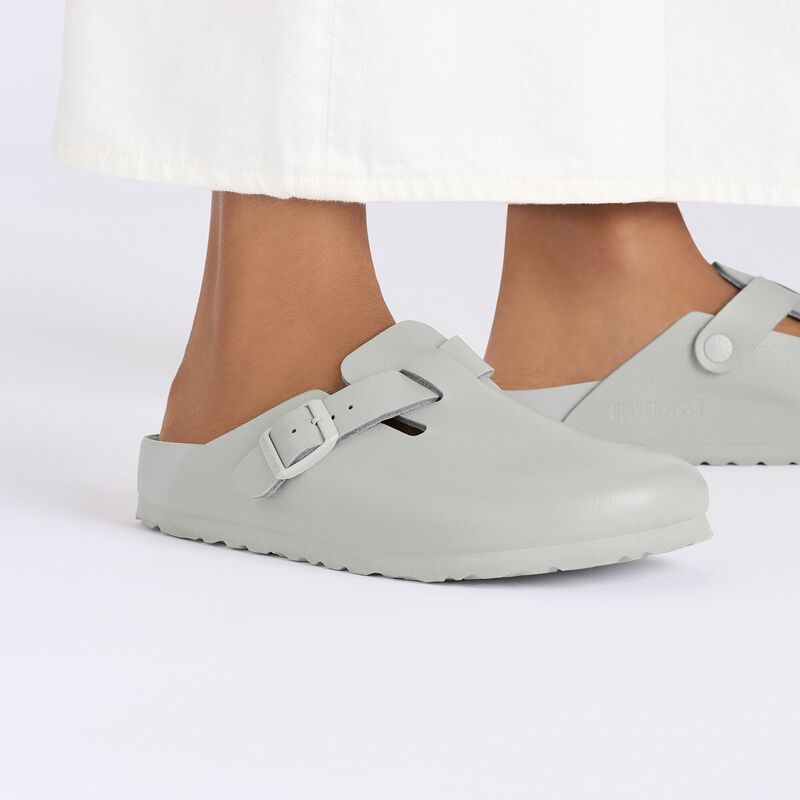
The Boston is a clog, not a lace-up. Its fit is governed by the strap across the top of the foot, which fastens with a metal buckle. That strap is your primary adjustment for width and volume. In the first week, you will likely adjust it more than once. Leather stretches, and the instep can change as your foot settles into the footbed.
Start with the strap snug but not tight. You should be able to slide a finger under the strap without forcing it. If the strap leaves a red mark after twenty minutes, loosen it one hole. If your heel lifts excessively when you walk, tighten it one hole. The goal is to keep the foot from sliding forward while allowing the toes to move freely. The Boston has no heel strap, so the instep strap does double duty: it holds the shoe on and it controls how much the foot can shift.
Mineral Gray natural leather has a finish that resists immediate staining but still breathes. Black natural leather behaves similarly, though it hides scuffs more readily. In either color, the strap will crease where it bends over the buckle. That crease is normal. It is the leather remembering your foot. Do not treat it as damage.
Width, Volume, and the Question of Socks
BIRKENSTOCK offers the Boston in narrow and regular width. The footbed itself is shaped to support the arch and allow the toes to spread, but the upper's width matters for comfort. A narrow foot in a regular-width Boston will slide, and the strap will have to be tightened to compensate. A wide foot in a narrow-width Boston will feel pressure at the sides. If you are between sizes, err toward the larger size, especially in a closed-toe clog where the toes need room to flex.
Socks change the equation. In the first week, thin socks can reduce friction against the leather and make the break-in gentler. Thick socks will fill volume and may require a looser strap setting. Many people wear the Boston barefoot in summer and with socks in cooler months. The footbed accommodates both, but the strap adjustment should be revisited when you change sock thickness. Walking on hard floors in socks alone is a different sensation than barefoot; the sock adds a layer that can mask the footbed's feedback. For the most honest break-in, alternate between barefoot and thin socks during the first week.
Walking on Hard Floors: What to Expect
Hard floors are where the cork-latex footbed proves itself. On carpet, almost any shoe feels acceptable. On tile or concrete, the footbed's support becomes obvious. The heel cup centers the heel. The arch support lifts the midfoot. The toe bar—the slight ridge under the toes—encourages a natural push-off. In the first week, these features may feel aggressive. By the end of the week, they should feel less like intrusions and more like guidance.
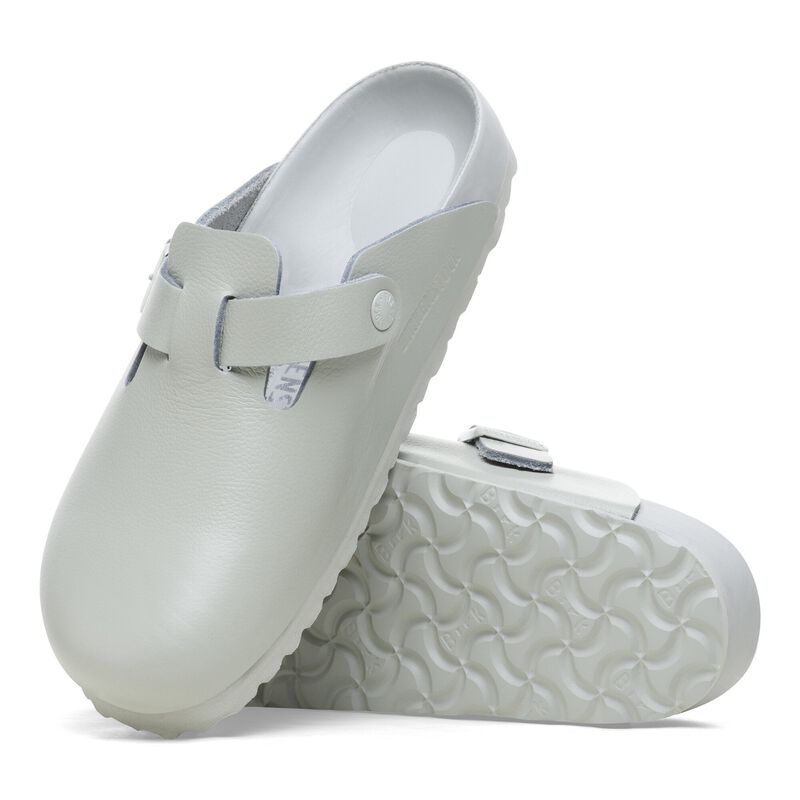
The soft sole on this Boston model is a layer of cushioning between the cork and the ground. It does not make the shoe a sneaker. It does take the sting out of standing on a hard kitchen floor for an hour. If you are transitioning from a heavily cushioned shoe, the Boston will feel flat and firm at first. Give it time. The footbed is not meant to be soft; it is meant to be supportive. Softness comes from the cork adapting to you, not from foam compressing under you.
Walking on hard floors also exposes any fit issues quickly. If the strap is too loose, you will feel the heel slip. If the footbed is too narrow, you will feel pressure at the ball of the foot. If the arch is too high for your foot, you will feel it immediately. These are not reasons to abandon the shoe. They are reasons to adjust the strap, try a different width, or simply allow more time. The first week is a conversation between your foot and the cork. Hard floors make that conversation louder.
Birko-Flor, Natural Leather, and This Particular Boston
This Boston is made with natural leather, not Birko-Flor. Birko-Flor is BIRKENSTOCK's synthetic upper material, durable and easy to clean, often used on the Arizona and Madrid. Natural leather is different. It is skin. It breathes, it creases, and it develops a patina. Mineral Gray natural leather will lighten slightly at the flex points and darken where the strap rubs. Black natural leather will show scuffs as a lighter gray before they can be brushed away. Both are part of the character of the material.
The Arizona, the Boston, and the Madrid share the same cork-latex footbed philosophy, but they fit differently. The Arizona is a two-strap sandal with open sides. The Madrid is a single-strap slide. The Boston is a closed-toe clog. If you know your size in the Arizona, the Boston will likely be the same footbed size, but the upper will feel more enclosed. That enclosure is why the strap fit matters so much. In the Arizona, the straps hold the foot from above and behind. In the Boston, the instep strap is the only anchor. Adjust it with care.
Break-In Is Not a Test of Endurance
There is a myth that BIRKENSTOCK footbeds require weeks of pain before they become comfortable. That is not the brand's intent. The cork-latex footbed is designed to support the foot from the first step. It does become more comfortable as it molds, but it should not cause blisters or sharp pain. If it does, the fit is wrong. Check the width. Check the strap. Check the size. A well-fitted Boston feels firm but not punishing in the first week.
German craft is evident in the consistency of the footbed. The cork is ground and mixed in Germany, the latex is natural, and the assembly is done in the brand's own factories. That consistency means that a size 42 regular-width Boston will feel like a size 42 regular-width Boston, whether it is black or Mineral Gray. The variables are your foot and how you wear it.
By the end of the first week, you should notice that the footbed feels less like a foreign object and more like a base. The leather will have started to soften. The strap will have found its setting. The hard floors will still be hard, but your foot will have learned how to meet them. That is the point of the Boston. It is not a shoe that does the work for you. It is a shoe that lets you do the work yourself, with support underneath. Walking as nature intended is not about bare feet on grass. It is about giving the foot what it needs to function, and then getting out of the way.
View this BIRKENSTOCK style in the shop
People also search
BIRKENSTOCK sandals waterproof options EVA
BIRKENSTOCK footbed technology cork and latex
BIRKENSTOCK sandals for nurses and long shifts
BIRKENSTOCK Arizona last chance colors worth buying
BIRKENSTOCK Arizona two strap too loose how to tighten
do BIRKENSTOCK sandals run small or large
BIRKENSTOCK Arizona taupe vs stone vs black which to buy
BIRKENSTOCK Boston suede water stains how to clean
BIRKENSTOCK Arizona vs Boston which is better for walking
BIRKENSTOCK oiled leather clog care rain and commute
BIRKENSTOCK Arizona mocha vs dark brown
best BIRKENSTOCK for city walking tour
BIRKENSTOCK men women unisex sizing how to choose
BIRKENSTOCK Arizona white vs black everyday wear
BIRKENSTOCK cork latex footbed how long it lasts
BIRKENSTOCK sandals lightweight hiking light trails
BIRKENSTOCK cork footbed squeak how to fix
BIRKENSTOCK Arizona mink vs tobacco oiled leather
can you wear BIRKENSTOCK Boston in rain
best BIRKENSTOCK for backyard home and errands
best color BIRKENSTOCK Arizona for everyday
BIRKENSTOCK Mayari toe loop vs Gizeh fit
best BIRKENSTOCK for airport travel and long flights
BIRKENSTOCK Kyoto vs Boston clog comparison
BIRKENSTOCK soft footbed vs original footbed difference
BIRKENSTOCK sizing EU to US conversion chart
how to choose BIRKENSTOCK width letter R or N
BIRKENSTOCK Boston Natural Leather Mineral Gray Soft Sole sizing and width fit
best color for BIRKENSTOCK Boston Natural Leather Mineral Gray Soft Sole everyday wear
BIRKENSTOCK wide width sandals for high volume feet
Trending BIRKENSTOCK searches
BIRKENSTOCK Mayari
BIRKENSTOCK EVA sandals
summer BIRKENSTOCK outfits
Birkenstock clog socks
BIRKENSTOCK stone Arizona
two strap sandal
BIRKENSTOCK city walking
BIRKENSTOCK Big Buckle
BIRKENSTOCK Madrid sandal
BIRKENSTOCK vegan Birko-Flor
BIRKENSTOCK white Arizona
BIRKENSTOCK airport shoes
oiled leather clog care
BIRKENSTOCK soft footbed
break-in cork footbed
BIRKENSTOCK oiled leather
BIRKENSTOCK cobblestone walking
Arizona vs Madrid
cork footbed care
BIRKENSTOCK platform Arizona
