



Function
Madrid Big Buckle Nubukleder Old Rose Soft Sole: Korkbett-Einlaufanleitung für die erste Woche | BIRKENSTOCK Offiziell
Walking as Nature Intended, From the First Step
BIRKENSTOCK has been shaping cork around feet since 1774, and the Madrid is the purest expression of that lineage: one strap, a contoured footbed, and nothing between you and the ground. This version, in Old Rose nubuck leather with a soft sole and an oversized Big Buckle, adds a little more give underfoot and a little more presence up top. It is a sandal that asks you to walk, not to stand around looking at it. What follows is a practical account of the first week — how the cork-latex footbed breaks in, how to dial in the strap, and what hard floors teach you about your own gait.
The Cork-Latex Footbed: A Living Surface
The heart of any BIRKENSTOCK is the cork-latex footbed. Cork granules are harvested from the bark of the cork oak, a tree that regenerates its outer layer every nine years, then mixed with natural latex and pressed into a shape that mirrors the underside of a healthy foot. It is not foam. It is not gel. It is a semi-rigid, slightly resilient material that responds to pressure and body heat over time. In the first few days, the footbed feels firm — almost unyielding under the heel and along the arch. That is correct. Cork does not soften by collapsing; it softens by adapting. Each step compresses the cork granules microscopically, and by the end of the first week you will feel a shallow cup forming under your heel and a gentle rise settling into your arch. The process is slow, and that is the point. A footbed that molds instantly would stop supporting you instantly.
Why the First Week Feels Different
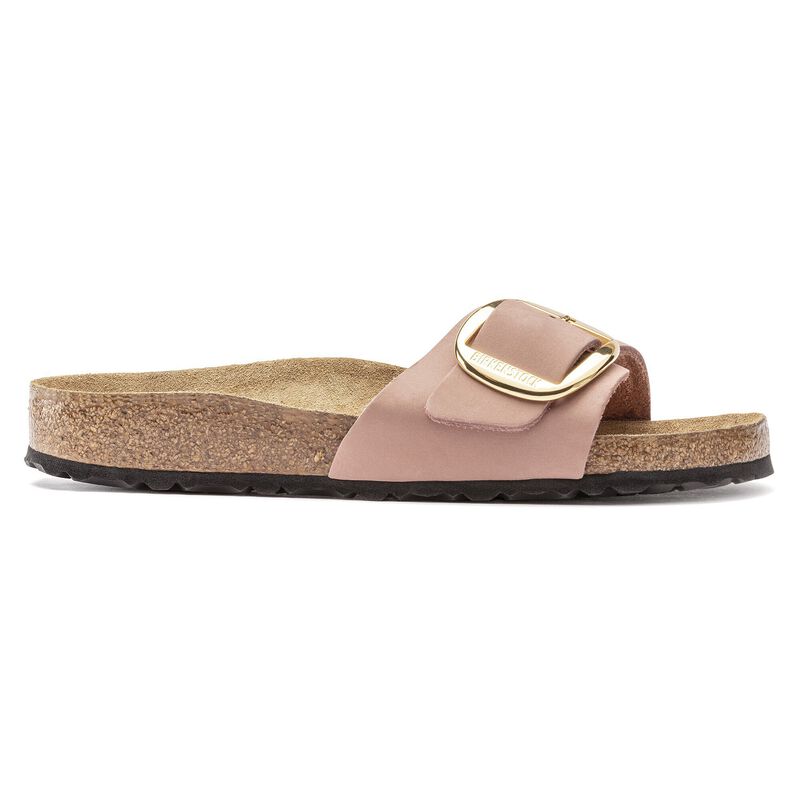
Most modern shoes are built on flat, cushioned soles that let the foot fall inward and the toes grip for balance. The Madrid does the opposite. Its footbed has a raised arch, a deep heel cup, and a toe bar just behind the toes. In the first days, these features announce themselves. You may feel pressure along the inside of your arch or a new awareness of your heel sitting deeper than usual. This is not a defect; it is the footbed asking your foot to remember its own architecture. The soft sole under the cork adds a layer of forgiveness — a thin cushion that takes the edge off hard surfaces without masking the contours. By day three or four, the pressure fades into a kind of quiet support, and by day seven the footbed feels less like a foreign object and more like a cast of your own step.
Setting the Big Buckle Strap
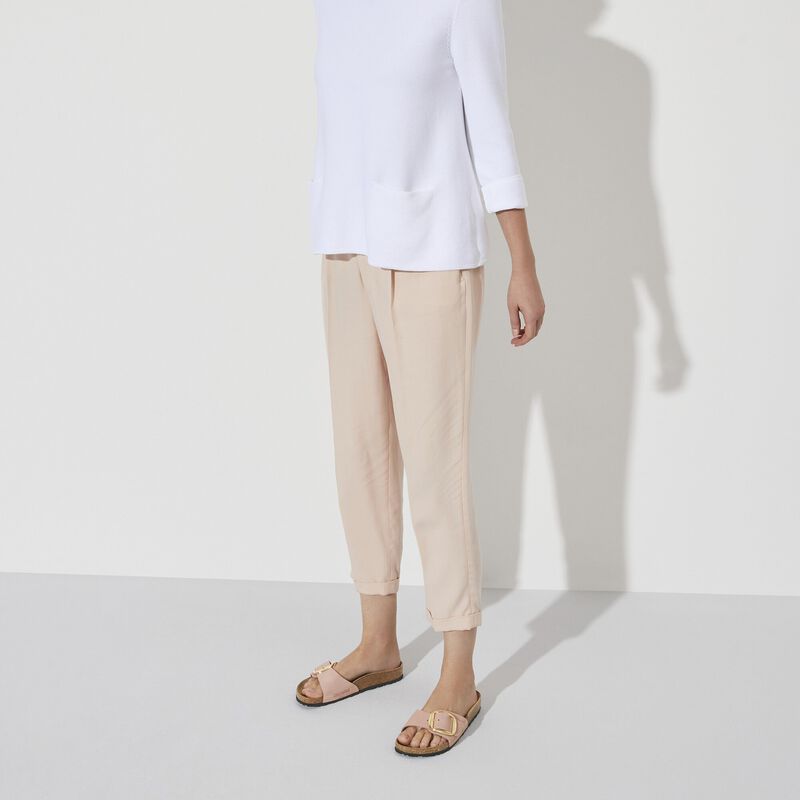
The Madrid's single strap crosses the instep just below the ankle bones. With the Big Buckle, you have a wide, adjustable metal buckle and a generous range of holes. The mistake most people make is tightening the strap until the sandal feels secure like a sneaker. Resist that. The strap should hold the footbed against your sole without pinching the top of your foot. You should be able to slide one finger between the strap and your instep with slight resistance. If the strap leaves a red mark after ten minutes, it is too tight. If your heel lifts out of the cup when you walk, it is too loose. Nubuck leather — here in a muted Old Rose — has a matte, velvety surface that softens with wear and takes on the shape of your instep. In the first week, adjust the buckle once in the morning and once in the afternoon; your feet swell during the day, and the leather is still learning your contours.
Walking on Hard Floors: The Honest Test
If you want to know whether a footbed is doing its job, walk on tile, concrete, or hardwood. Carpet hides everything. Hard floors transmit every irregularity of your gait, and the cork-latex footbed answers in kind. On the first day, a hard floor will feel unforgiving — you will notice the heel cup, the arch, the toe bar. That is the footbed working. By the end of the first week, the same floor will feel different: your heel will land in the cup instead of on the edge, your arch will rest instead of reaching, and your toes will have room to spread behind the toe bar. The soft sole helps here, absorbing the sharpest vibrations without turning the sandal into a pillow. Walk barefoot on hard floors when you can, and wear the Madrid for short errands at first. Twenty minutes in the morning and twenty in the afternoon is enough to begin the molding process without overworking your feet.
Nubuck Leather and the Old Rose Finish
Nubuck is leather that has been buffed on the grain side to create a soft, suede-like nap. It is more breathable than smooth leather and more forgiving across the instep, which makes it a natural match for a single-strap sandal. The Old Rose color is a dusty, muted pink — warm without being loud, and it deepens slightly as the leather absorbs the natural oils from your skin. Do not treat it with heavy waxes or silicones; a soft brush and a damp cloth are enough to lift dust. If the nap becomes shiny in spots, that is simply the leather adapting to the pressure of the strap. It is a sign of wear, not damage. The Big Buckle is made from the same metal as all BIRKENSTOCK hardware, and it will develop a subtle patina over time.
Width, Fit, and the Madrid Last
The Madrid is built on a narrow last, which means it runs slightly slimmer than the Arizona or Boston. If you have a wider foot, the nubuck will stretch across the instep, but the footbed itself does not widen. Pay attention to the length: your heel should sit inside the cup, and your toes should rest behind the toe bar without hanging over the front edge. A little space at the back and sides is normal — the footbed is designed to guide the foot, not to grip it. The soft sole adds a few millimeters of cushion but does not change the footprint. If you are between sizes, choose the larger one; cork compresses, but it does not lengthen.
A Note on Break-In Expectations
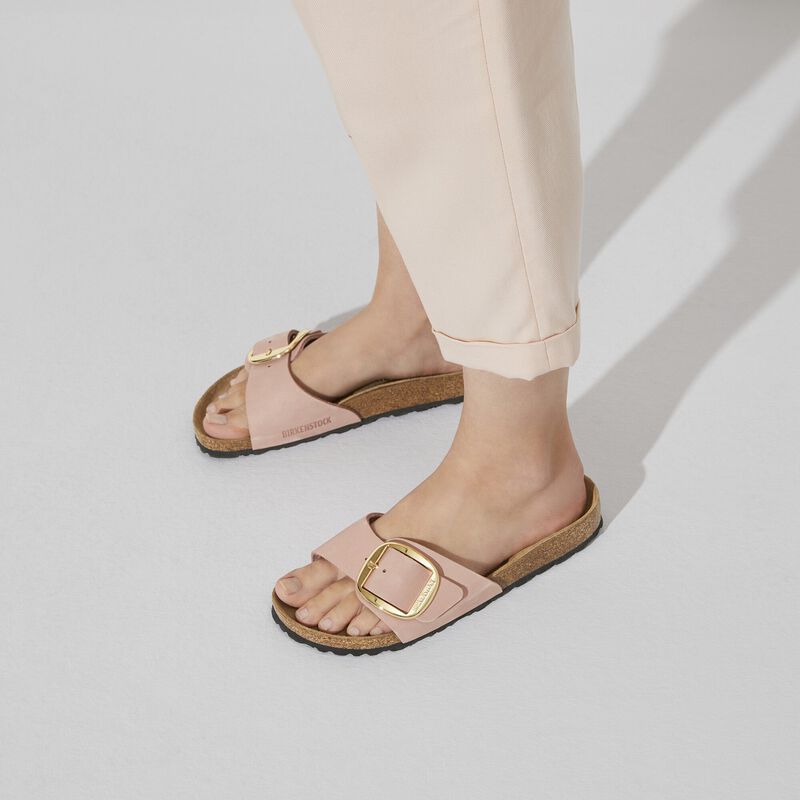
Some people feel at home in the Madrid on the first day. Others need a week or two. Both are normal. The cork-latex footbed is not broken in by walking miles; it is broken in by walking often. Short, frequent wear is better than one long hike. Keep the sandal in a dry, shaded place when you are not wearing it. Avoid leaving it in a hot car, where the cork can dry and the latex can degrade. If the footbed feels damp after a long day, let it air out overnight — cork breathes, but it does not appreciate being sealed in a plastic bag.
The Heritage Behind the Shape
BIRKENSTOCK's footbed has not changed fundamentally in decades because it does not need to. The proportions — the heel cup, the arch, the toe bar, the neutral heel-to-toe drop — are based on the average anatomy of the human foot, refined through generations of German craftsmanship. The Madrid takes that footbed and removes everything unnecessary: no heel counter, no laces, no padding for its own sake. What remains is a strap, a buckle, and a surface that asks your foot to do what it already knows how to do. The first week is a conversation between your foot and the cork. By the end of it, the sandal will feel less like something you put on and more like something you walk in.
Practical First-Week Rhythm
Day one: wear the Madrid indoors for twenty minutes. Adjust the strap so it is snug but not tight. Day two: walk on a hard floor for ten minutes, then switch to carpet. Day three: wear them for a short errand — a walk to the mailbox or around the block. Day four: check the strap again; the nubuck will have relaxed slightly. Day five: stand in place for a few minutes and notice where the footbed presses. Day six: wear them for an hour total, split into two sessions. Day seven: walk on tile or concrete for twenty minutes and pay attention to how your heel lands. If you feel pain — not pressure, but pain — stop and check the fit. The cork-latex footbed should feel supportive, not punitive. By the end of the week, the Old Rose nubuck will have taken on the first faint lines of your own stride, and the footbed will have begun its long, slow work of returning your walk to nature's blueprint.
View this BIRKENSTOCK style in the shop
People also search
BIRKENSTOCK Arizona vegan Birko-Flor vs leather
BIRKENSTOCK Gizeh thong sandal vs Arizona two strap
BIRKENSTOCK sizing guide regular vs wide width
BIRKENSTOCK Arizona white Birko-Flor scuff care
BIRKENSTOCK Arizona regular width vs wide fit guide
BIRKENSTOCK Arizona mocha vs dark brown
BIRKENSTOCK Gizeh regular vs platform
BIRKENSTOCK suede vs nubuck which scuffs less
BIRKENSTOCK EVA sandals for beach and pool
BIRKENSTOCK men women unisex sizing how to choose
how to stop heel slipping in BIRKENSTOCK Arizona
BIRKENSTOCK sandals for plantar comfort walking
best BIRKENSTOCK clog for indoor and outdoor
BIRKENSTOCK Boston for office casual dress code
how to know BIRKENSTOCK size from foot length
how often to replace BIRKENSTOCK cork footbed
BIRKENSTOCK footbed sandals break-in no blisters
BIRKENSTOCK Boston shearling vs regular Boston
how long to break in BIRKENSTOCK cork footbed
best BIRKENSTOCK for airport travel and long flights
BIRKENSTOCK Arizona for summer walking all day
BIRKENSTOCK Arizona taupe vs stone vs black which to buy
BIRKENSTOCK sizing EU to US conversion chart
BIRKENSTOCK Boston suede water stains how to clean
BIRKENSTOCK Arizona Big Buckle vs classic Arizona
BIRKENSTOCK Boston fit compared to Arizona
BIRKENSTOCK kids vs adult sizing for small feet
BIRKENSTOCK sandals waterproof options EVA
BIRKENSTOCK Arizona vs Boston which is better for walking
BIRKENSTOCK Boston break in time first week
Trending BIRKENSTOCK searches
Madrid Big Buckle Nubuck Leather Old Rose Soft Sole cork footbed
ankle strap Milano
BIRKENSTOCK tobacco leather
BIRKENSTOCK cobblestone walking
Madrid Big Buckle Nubuck Leather Old Rose Soft Sole Birko-Flor
BIRKENSTOCK cork footbed
BIRKENSTOCK travel sandals
arch support sandals
BIRKENSTOCK Milano
BIRKENSTOCK shearling Boston
BIRKENSTOCK Gizeh
BIRKENSTOCK Mayari
Madrid Big Buckle Nubuck Leather Old Rose Soft Sole oiled leather
BIRKENSTOCK Madrid sandal
cork footbed care
thong sandal Gizeh
contoured cork-latex footbed
BIRKENSTOCK last chance
all day walking sandals
BIRKENSTOCK original footbed
